Saturday, August 20, 2016

Mid Winter MEDEVAC


And...I'm back for a few more posts from the South Pole! This one will focus on the historic mid-winter MEDEVAC that flew two team members out at the end of June. I'm sure that by now everyone has heard about it and the media has moved on to more current news. Although it was made to look easy and routine it was a monumental effort on the part of everyone involved, from those here at Pole to everyone back on "earth" and the flight crews who took the biggest risk flying two planes down from Canada. Almost pole to pole! I will not be including ANY info about the two team members that were flown out, don't ask.

Over the past few months we have completed some major projects, are close to completing others and starting a few more. Busy times indeed. All have been performed with no injuries and we hope to end the season without any incident. Good times...

We have become accustomed to the weather at the bottom of the world and most here will agree that -90F temps with low wind speeds are better than -50s F with winds. The darkness is starting to subside with the sun a mere 12 degrees below the horizon and slowly spiraling upwards. Several months of complete darkness has been a bit surreal, but enjoyable. There's nothing like taking a mid day walk in pitch black darkness! There is now a faint glow of light on the horizon letting us know that soon we will see the sun. Let the sun bring the heat! And the planes that will take us back to civilization.


MEDEVAC:

The planning for the operation was extensive, from everything that had to go right to everyone being where they needed to be at the right time. We couldn't have asked for better weather conditions during the operation with clear skies, low winds and temps within the operating parameters of the planes and equipment that were needed. And a full moon that provided much needed light. 

All of the below pictures were taken by Robert Schwarz, a long time resident of the South Pole.

Several days prior to the arrival of the plane there was much to do here at Pole. Buildings needed to be pulled off the storage line and brought out to the flight line and set up for everything from electricity to fuel and more. These building are not left out near the flight line during the winter months due to snow drifting that will swallow up anything left out in the open. 


The eight thousand foot ski-way needed to be groomed with heavy equipment towing attachments for the process. Several passes were needed and many hrs were put in by those doing the work to ensure that the plane that would be landing on skis could do so safely.


Burn barrels and lighting needed to be set up and tested to ensure that everything would work properly before and during the operation. Although the burn barrels are rudimentary they can burn for 8 hrs plus without being blown out. The lights seen below were designed and placed to indicate the middle of the ski-way on final approach with the burn barrels placed on the left of the ski-way. This information plus much more was relayed to the inbound flight crew in advance for situational awareness on approach.


 As luck would have it, the weather continued to cooperate for the inbound flight. After leaving Chile the crew had to fly across the Drake Passage to Antarctica taking advantage of a small weather window that seemed to be called for at the precise moment. Two planes made the flight down, both landed at the British research station Rothera on the Antarctic peninsula, one stayed behind as a back up and search and rescue if needed while the other was outfitted with skis and flew to the South Pole. The weather was still good once the crew left Rothera for Pole, a rarity this time of the year on the continent. On final approach the crew reported that they could see the burn barrels 10 miles out which spoke to the visibility that day and the effectiveness of the low tech solution that the barrels provided. Soon we could see the plane in the distance lining up for landing.


Once on the ice the plane taxied to the end of the ski-way and was guided into position by one of our fuels techs. The plane needed to be parked at a certain location and distance from the buildings to be refueled.


Another low tech solution that was used were bamboo pads constructed a few days prior. Bamboo is used for the flagging that is found throughout the continent, cheap, effective and versatile, even here. The pads were needed to prevent the plane's skis from freezing to the ice, something that occurs regularly at certain temps. Once the pads were placed the plane moved forward onto them. In the below picture one of the pads is visible at the front of the plane. 


Once the plane was parked at the needed location everyone assigned swooped in to assist with unloading the crew's gear and other necessary equipment for patient evaluation and transport. One critical factor also worked on immediately was keeping the engines as warm as possible. First, specially designed blankets were wrapped around the engines to assist in heat retention.


Second, we rolled out the big guns! Portable heaters that would be used to heat the engines and the cabin, not for comfort but to avoid the freezing of any avionics inside. Everything needs to work in order to fly in the dark, even more so in the middle of an Antarctic winter while at the South Pole with temps in the mid -70s F.


While the plane was closed up for the "night" and heated the flight crew headed inside to warm up, eat and get some much needed sleep after the eight hour flight across the continent. The following morning while the patients were being evaluated the planes were loaded up with the out going gear.


Once all of the gear and needed equipment was loaded onto the plane the patients were then transported out to the flight line one at a time. Everyone involved here at Pole had specific tasks that they were responsible for. I was the safety risk assessment lead and also responsible for escorting and ensuring that one of the two being flown out was ready to go and had all of the necessary gear and personal documentation that would be needed for them to travel once off continent. That's me below with the blue bag, the one bag that the patient was allowed to take due to weight limitations on the plane. Everything that went onto the plane was weighed and calculated to ensure that it could take off.


After everything and everyone was loaded onto the plane the area needed to be cleared of heaters, lighting and everything else that had been brought out prior to the plane being able to start its engines.


With everything cleared the flight crew did a pre-flight check, started and warmed up the engines and proceeded to taxi onto the ski-way. This takes longer than you would think and we were all starting to get a bit cold after more than an hour out in the elements. But no one wanted to leave until we saw the plane airborne.


The taxi to the end of the runway seemed to take forever and at one point we thought that it might have gotten stuck to the ice. Luckily that was not the case and heard the engines rev up as it started its way down the ski-way for take off. It took every bit of the length provided for the plane to get airborne. Some of us held our breaths until we saw it in the air. It was a spectacular sight to see and a testament to all of the planning and hard work that went into pulling this off.


Eight hours later we received notification from Rothera that the plane had landed safely and that the patients were being transferred onto the awaiting plane with a fresh crew that would take them the rest of the way across the Drake Passage to Punta Arenas, Chile. That flight also caught a small window of good weather across the Drake and made it to Chile safely.

Busy times at the South Pole...

Next Post? Science! The reason we're all here, all 46 of us.


Sunday, April 24, 2016

Answering Questions

The weather is not only extreme at the South Pole but also "moody" We have seen 80 degree temperature swings within a single week. -50 F is now considered awesome. A far cry from that first day at Pole when -29 F was a shock.


There is still a faint glow of sun light on the horizon and the sky is slowly filling with stars.
We might not see the sun as we once did but the moon rising is just as amazing from our perch at the bottom of the world.


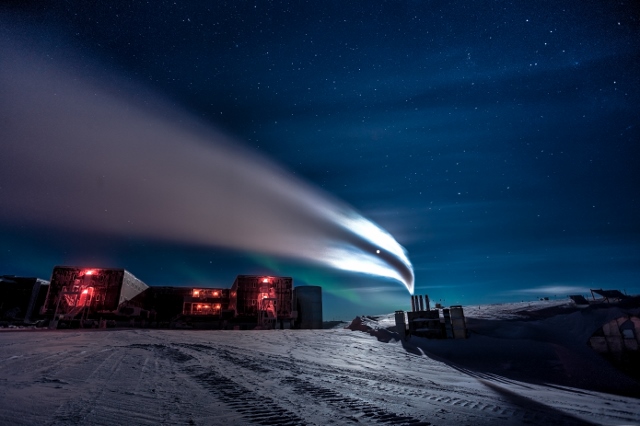
The Auroras are starting to let themselves be seen. At times in combination with the moon and other beautiful sites. In the below image the full moon is seen through the generator exhaust plume and the Auroras just above the station to the right. The red lights you see are due to experiments and cameras that are light sensitive. The majority of the science at the South Pole takes place during the "long dark night".


Where else can one see a moon so clear that you could almost reach out and touch it? Space! 


Oh yeah, the questions:

Brian Payne asked what creature comforts I brought with me. 
I have to say that the most use goes to my music player and my wireless headphones and the plethora of music and nature sounds that I brought with me. I listen to different things every morning. At times thunderstorms or birds in the forest and even waves breaking on a shore. I don't only listen to those sounds for relaxation but to fill the void that is created by the silence and darkness of the South Pole. Sensory deprivation can sneak up on you if not recognized. Sights, sounds and smells that we take for granted back home are non existent here. I also brought dozens of pictures from around the world. They give me a window onto those sights that I wont be seeing for some time. As I type this I am listening to Beethoven and have a picture of a creek running through a pine forest on my secondary screen. Nice!

Garry Reese asked what a typical work day is like at the South Pole.
It varies depending on what you do. Mine starts with going to the gym at 0400, followed by breakfast at 0600, then at 0645 I review e-mails and the day's plan. At 0730 my department meets for morning stretching followed by a morning safety and work planing meeting at 0800. There are three Utility Techs, three Fuels Operators, one Electrician, one Plumber, one Facilities Engineer and a Fire Alarm Tech within our department. We are complimented by a Safety Engineer that assists with daily safety planing. 

There are a variety of ongoing projects, repairs and maintenance tasks that we are responsible for. Knowing the priorities and planing accordingly is paramount. Once all tasking and safety is reviewed everyone heads out to different locations throughout the station and outlying science and support buildings. I then meet with the Station Manager and other departments to include science to coordinate any needs. The support of science at the South Pole is our primary objective. We keep everything running so they can conduct their science. Out here electricity and other utilities are not just luxuries, they are life support. We lose any of them and things can get difficult if not dangerous. No one can come in to help. We are on our own until the first flights start arriving in October. We might as well be on another planet. 

At 1200 we have lunch followed by a brief overview of the mornings activities then it's back to our planned tasking. I coordinate pending work with the Work Order Scheduler, plan, coordinate and assist with projects and walk to different science and support locations to review any issues that may have an impact on station systems. Those walks can at times put you a mile from the main station giving one the opportunity to take in the dark and quiet landscape. By 1700 we discuss any findings and or pending issues and head off to dinner at 1730. Lights out for me is usually 1930 hrs. There you have it. A day (night) at the South Pole!


Next Post? Outdoor Gear 


Sunday, April 10, 2016

Sunset Dinner

After a while you really start to get used to seeing the day's weather. What we start to pay attention to the most (at least I do) is the felt altitude. A few hundred feet make a big difference in how you feel since it has a direct correlation with the oxygen you can take in. Sleeping becomes restless and walking stairs or handling anything with any weight becomes a chore. The station sits at 9,301 feet above sea level. Today the pressure is making it feel like 11,299 feet above sea level. Slow and steady is the order of the day.


On clear days we can still see a little light on the horizon. On days with overcast and high winds kicking up snow (such as today) it seems darker. We are finally seeing stars pop in the sky and traveling planets (Saturn and Mars) just above the horizon reminding us of where we are. The sky we will see will be completely alien to most of us with Orion upside down only kicking his legs just above the horizon. We are looking forward to the complete darkness that will bring out the best sky seen from earth.


Not to long ago we celebrated one of many special days here at the South Pole with a fantastic meal.
Sunset Dinner. I'm hesitant to list the menu since you know, we are at the bottom of the world roughing it. Right? Well, here it is:

Hors D’oeuvres
Shaved Prosciutto, 3 Olive Tapenade, Assorted NZ Cheese, Basil Oil
Baked NZ Brie, Mango Chutney
Rock Crab Cake, Cajun Imperial

Soup
Maple Butternut Squash

Salad
100% Greenhouse Salad
cucumber, cherry tomato, basil vinaigrette

Main
Five Spice Seared Duck Breast
blackberry-foie gras glacé
Vanilla-Rum Poached Maine Lobster
honey-parsnip puree, balsamic reduction
Polenta, Beet, Avocado, Porcini Mushroom Napoleon
charred tomato coulis
Maple Roasted NZ Root Vegetables
Kikorangi Blue Cheese Potatoes

Dessert
Applewood Smoked Bacon Liquid Nitrogen Ice Cream
Chocolate Praline Chiffon Cake

Our chef Darby Butts (from Annapolis MD.) and his stellar staff KC Loosemore, Ryan Evans and Jennah King did a spectacular job (as always) proving that even here at the South Pole excellent dining can be had.

The galley was rearranged for this meal giving it an elegant and welcome feel.


The station population showed up wearing their South Pole best and some volunteered to provide support as stewards making sure that everyone had a full glass during dinner and clearing as needed before the next course.


Science was present to provide the essential ingredient for the ice cream. Liquid nitrogen.


After dinner everyone pitched in to reset the galley and most joined in on a friendly post dinner card game. Good times at the South Pole!


Next Post? Answering Questions (If you have any, please list them in the comments area below)

Wednesday, March 30, 2016

South Pole Rides

Today was a nice day for what we have seen and will see.


And it's gone! We will not see the sun again until October.


Rides....We have them. The vehicles have operational restrictions for use with regard to temperatures. None run well in the extreme cold and they can only be used for station critical operations during the winter months. During the summer months vehicles are used for snow removal, transportation of personnel and materials to different locations around the station, cargo and fueling. The most basic being snowmobiles.


All rules apply. You must be trained and use all of the required personal protective equipment before being allowed to drive any of the vehicles on station. Even then, use is specific to your job requirements. Recreational use is prohibited.


One of my favorite vehicles is the tracked van. The thing is just cool! I'd like some of those tracks for my truck back home :)


Others are intended for rougher, longer hauls onto the ice.


And then there are the heavy lifters that can do just about anything.


But when winter hits and temps drop all of the above are subject to breakdowns that can be costly to repair and we don't have a parts store down the street. At those extreme temperatures we rely on the oldest most proven method of transportation. Walking! Dress properly, hydrate often and eat lots. It's amazing what the body can endure. I'm in the background below. The other gentleman is a six foot plus fire tech. We were on our way back from the dark sector labs (more on the labs in the future). A two mile round trip outing. Good times! 


Next Post? Sunset Dinner
  

Friday, March 25, 2016

The Ice Tunnels

Over the past few days the weather has not permitted good visibility. I'll refer you to my last post for weather info. Cold is just cold after a while. I never thought I would consider -60F "nice". The weather (visibility) finally broke allowing a view of the ever setting sun. A spectacular one at that. Today the sun is completely below the horizon but we will still see the glow during a period of twilight that will last few weeks. On one side we have the setting sun.


And to the other a rising moon. Just amazing to see. Pictures do not do these two justice. At least not with my camera.


You are probably wondering about the mentioned ice tunnels. There are about two thousand feet of utility tunnels under the ice at approximately forty feet below the surface. These tunnels were originally cut by a large machine and are now maintained with smaller hand held electrically powered chainsaws. The ice is continually on the move and periodically utility lines need to be adjusted and tunnels widened to accommodate the shift. That's me in the picture for scale.


The temps hover around -60F year round keeping things really frosty all the time. The slightest bit of moisture freezes almost instantly.


Some of the tunnels are rather tight spaces. Other areas can be cavernous in comparison and rather surreal at first glance.


Throughout the tunnels some have left decorations arranged in a manner that highlight the properties of the ice. In the below image a five inch diameter hole was bored into the tunnel wall and small items placed within it. The blue seen is light from above reaching through the Ice.


Near the station water well more moisture is present and it reacts to the cold with spectacular displays. Our water is melted from ice deep enough to be a few thousand years old. The water we drink was surface snow when the Romans still ruled part of the old world. Water so pure and devoid of minerals that it has to be treated prior to consumption.


Next Post? South Pole Rides


Sunday, March 20, 2016

Station Interior Part 4 - Inside The Arches and Under The Ice


Today was by far the coldest day I have experienced at the South Pole. Pressure has dropped, making the felt altitude also a challenge when walking around. And the sun hasn't even set yet! The sun is currently at about two degrees above the horizon still spiraling downward ever so slowly. The mother of all sunsets.


Several posts ago I covered the exterior of the station. In one of the pictures there were two huge arched structures under the ice and snow. These arches hold other buildings and storage areas within them. One arch is the vehicle maintenance facility entrance and the other is the logistics and storage arch. The vehicle maintenance facility is well heated and used for storing certain tracked vehicles during the winter. There is also another bay for working on other equipment. Behind the VMF are welding and utility shops.


The logistics arch is where all incoming material and supplies are sorted and stocked in the appropriate location for later use. Some items can not be frozen and are located in the heated building within the arch.


 The arches are very cavernous and provide plenty of square footage for storage of all kinds of items to include our frozen food items. Temperatures outside of the heated building hover around -55 F. Toasty compared to the -82 F outside today! 


Beyond the the arch seen above there is yet another arch of roughly the same size that holds all of our fuel in forty five 900 gallon tanks. Lots of fuel to get us through the winter. More on those in a later post. Connecting the main station to the arches is an under ice utility corridor. From this corridor one can access the main power plant and ice tunnels. Yes, ice tunnels.


Next Post? The Ice Tunnels 


Wednesday, March 9, 2016

Station Interior Part 3


Yeah, It's getting a bit chilly! From here on out I will post the day's weather and a picture of the sun as it spirals downward ever so close to the horizon. It is currently five degrees above the horizon.


Well, we are running out of fresh fruits and vegetables. Before long the only "fresh" produce we will see will come from the station green house. We get lettuce, cucumbers, tomatoes, herbs and more from it. Enough to get a taste of what is typically taken for granted back home.


Daily the grow lights are turned on and they are bright. So bright that sunglasses are nice to have if in there for long. Every Sunday morning I sit in the greenhouse lounge for about an hour, reading and listening to bird song. Yup, I brought a selection of nature sounds with me since I knew there would be things I would not hear for a while. I'm glad I did. The space is very humid and smells of plants. A nice reminder of home and very relaxing.

Some have asked about my living quarters. I will say that at 8' X 10' they are very cozy and warm, affording me plenty of storage, a nice desk and a comfortable bed.


No, there is no window. I have an interior room. At first I thought that a window would be nice but hear that those rooms are much colder, have a lot of light coming in making it harder to sleep and soon there will be nothing to see for a long time once the sun sets. I also brought a lot of pictures of landscapes that I put up on my secondary monitor creating my own little window onto the rest of the world.

Next Post? Station Interior Part 4 - Inside the Arches and Under the Ice